
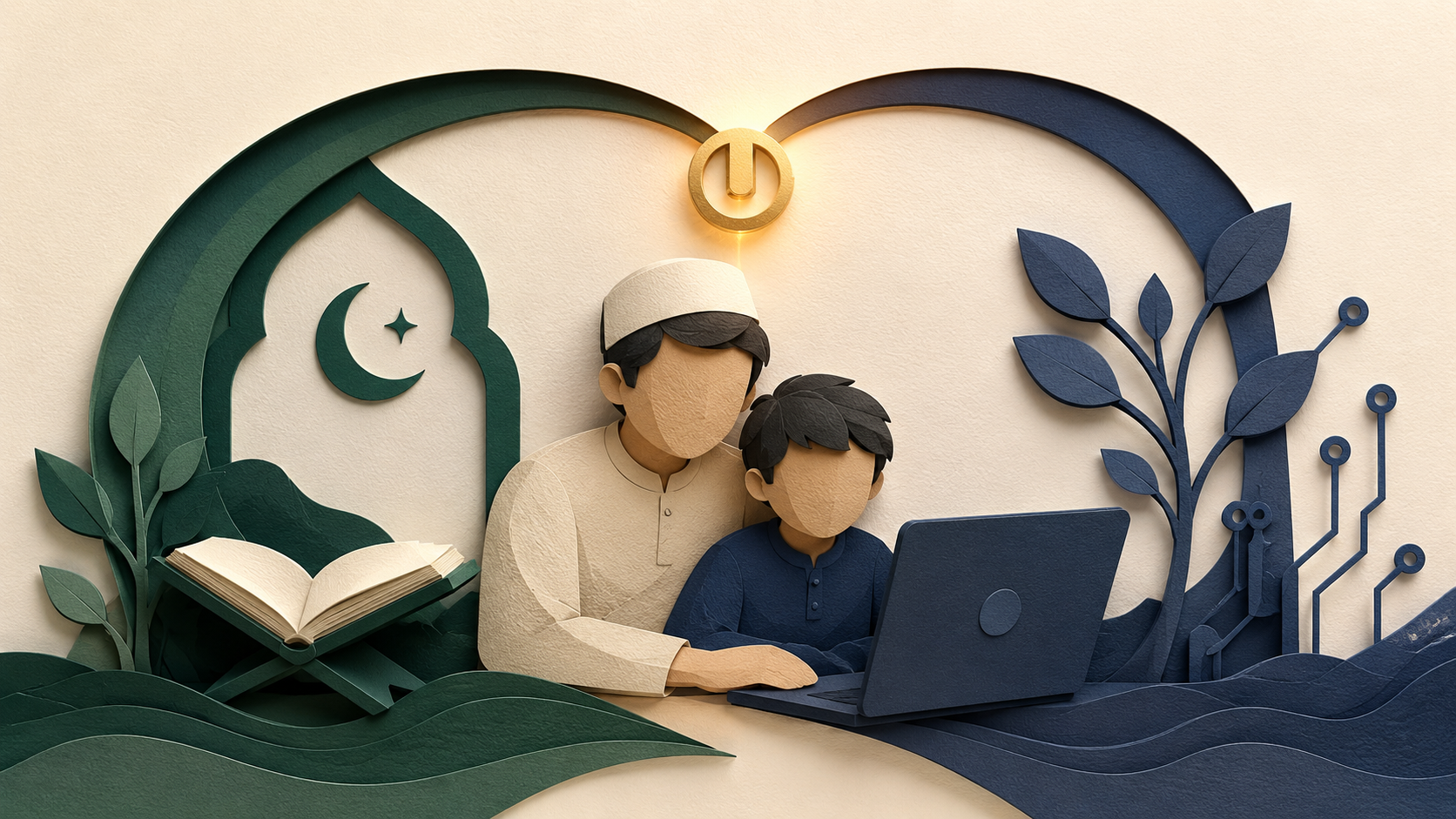
Raising a Muslim Child Where Islam Isn't the Norm
It is 7:40 in the morning. A mother in a small apartment kitchen is packing a lunchbox, and her nine-year-old son quietly asks a question that stops her hands mid-motion: "Mama, why do we have to be different from everyone else?"
Every Muslim parent raising children outside a Muslim-majority country knows this moment, or one very much like it. It might happen at a birthday party where the food isn't halal, or when a teenager wants to skip fasting because none of his friends understand Ramadan. The question changes shape, but underneath it is always the same tension: how do you raise a child to feel fully Muslim and fully at peace, in a world that wasn't built around that identity?
This is not a new struggle. The Sahabah who migrated to Abyssinia raised children among a Christian kingdom. What is new is the scale, and the speed of cultural messaging arriving through a screen that never mentions Allah.
A Father's Prayer That Speaks to Every Parent Here
Allah did not leave this struggle without guidance. The Quran preserves the words of a father worried about exactly this question.
رَبِّ اجْعَلْنِي مُقِيمَ الصَّلَاةِ وَمِن ذُرِّيَّتِي ۚ رَبَّنَا وَتَقَبَّلْ دُعَاءِ
Rabbi ij'alni muqima as-salati wa min dhurriyyati; rabbana wa taqabbal du'a
My Lord, make me an establisher of prayer, and [many] from my descendants. Our Lord, and accept my supplication.
What Ibrahim Did — and Didn't — Ask For
Notice what Ibrahim (peace be upon him) did not ask for. He did not ask Allah to remove every difficulty, or to make his descendants live in a world free of temptation. He asked for something more realistic and more powerful: that his children would remain people who establish prayer, wherever they ended up living.
That is the real goal of Islamic parenting in a non-Muslim society — not isolation from the world, but establishment in worship regardless of the world around you.
يَا أَيُّهَا الَّذِينَ آمَنُوا قُوا أَنفُسَكُمْ وَأَهْلِيكُمْ نَارًا
Ya ayyuha alladhina amanu qu anfusakum wa ahlikum naran
O you who have believed, protect yourselves and your families from a Fire whose fuel is people and stones.
What the Prophetic Example Teaches
كُلُّ مَوْلُودٍ يُولَدُ عَلَى الْفِطْرَةِ، فَأَبَوَاهُ يُهَوِّدَانِهِ أَوْ يُنَصِّرَانِهِ أَوْ يُمَجِّسَانِهِ
Every child is born upon the fitrah (natural disposition toward belief in Allah), and it is his parents who make him a Jew, a Christian, or a Magian.
Environment Shapes a Child — On Purpose, Not by Accident
This hadith is often quoted about faith itself, but its deeper lesson applies directly here: children are not raised in a vacuum. Whatever environment surrounds a child most consistently will shape them most powerfully.
That is not a reason for fear. It is a reason for intentionality. If the outside environment will not reinforce Islamic identity by default, the home has to become the place where it is reinforced on purpose.
مُرُوا أَوْلَادَكُمْ بِالصَّلَاةِ وَهُمْ أَبْنَاءُ سَبْعِ سِنِينَ، وَاضْرِبُوهُمْ عَلَيْهَا وَهُمْ أَبْنَاءُ عَشْرٍ
Command your children to pray when they are seven years old, and discipline them for it when they are ten.
How the Scholars Understood Raising Children Amid Difference
At the same time, classical scholarship never counseled isolation as the solution. The early Muslim community engaged with the societies around it — trading, learning language and craft — while remaining anchored in aqeedah (creed) and ibadah (worship). The balance the scholars modeled was rootedness within the world, not withdrawal from it.
Shielding my child from every outside influence is the safest way to keep them Muslim.
Children raised in total isolation often struggle more, not less, once they eventually meet the wider world unprepared. Identity built only on avoidance tends to be fragile identity.
The Sunnah models engaged, confident presence in the world — not a bubble. Resilience comes from a strong home foundation plus real-world exposure, not from removing exposure altogether.
Five Things That Actually Help
Five practical lessons for raising Muslim children as a minority
- 01
Build identity before you build rules
Children who only hear "you can't, it's haram" without ever hearing "here is who you are and why it matters" experience Islam as restriction, not meaning. Rules without identity produce resentment; identity produces conviction.
- 02
Make the home the strongest environment, not the only one
You can't control every environment your child enters, but you can make the home the environment with the most gravity — regular family Quran time, visible practice, warm conversation about faith.
- 03
Answer hard questions instead of shutting them down
A child's question about a holiday or a dress code is a request for understanding, not rebellion. Shutting it down teaches them to stop asking you and start asking the internet instead.
- 04
Normalize Muslim community, not just Muslim rules
Isolation breeds fragility; community breeds resilience. Regular connection with other Muslim families and the masjid reminds a child they aren't the only one living this identity.
- 05
Model, don't just instruct
Children absorb far more from what they watch their parents do than from what they're told to do. Consistent prayer, honesty, and good character teach more than any lecture.
In practice
Do
- Talk warmly about what Islam gives you, not only what it forbids
- Answer a hard question patiently, even imperfectly
- Keep the home visibly, comfortably practicing the deen
- Build real friendships with other Muslim families
Avoid
- Lead every conversation with fear of punishment
- Isolate your child from all outside contact
- Punish honest questions with silence or anger
- Treat faith as something only performed, never discussed
A quick home self-check
Look for one moment this week to explain the beauty behind a practice.
Consider one small daily habit, like five minutes of Quran after a meal.
One new connection this month is enough to start.
Watch your own example for a week before adjusting theirs.
What This Looks Like in Real Families
The school dance
Challenge
A father's daughter comes home upset — she was the only student not attending the school dance.
Approach
Instead of repeating "it's haram," he sits with her, validates that feeling left out is genuinely hard, then talks about her modesty as a form of self-respect she is choosing, not something being taken from her.
Result
The rule stays the same. The relationship — and her understanding of *why* — grows stronger.
Jumu'ah attendance
Before
A teenage son wants to skip Jumu'ah prayer because none of his friends go — it's become a solitary, unwelcome obligation.
After
His mother starts inviting a friend's family to join them each week, slowly turning Jumu'ah into a shared, social part of his routine rather than a lonely one.
What to Focus On at Each Stage
| Stage | Parenting focus |
|---|---|
| Early childhood (0–6) | Warmth, simple language about Allah, gratitude, and belonging; modeling daily prayer and dua |
| Middle childhood (7–9) | Teaching prayer directly (per the hadith above), starting Quran memorization, simple explanations for practices |
| Pre-teen (10–12) | Reinforcing consistency, deeper "why" conversations, building Muslim peer friendships |
| Teen years | Open dialogue over confrontation, patience with pulling away, continued visible parental practice |
A simple identity-building timeline
- Ages 0–6
Foundation
Warm, simple language about Allah and belonging.
- Ages 7–9
Instruction
Direct teaching of prayer and basic practice, per the Prophetic example.
- Ages 10–12
Reinforcement
Consistency, deeper conversations, Muslim community-building.
- Teen years
Dialogue
Patient, open conversation; parental modeling matters more than lectures.
| Approach | What it looks like | Common outcome |
|---|---|---|
| Isolation | Shielding the child from nearly all outside contact | Fragile identity that struggles once exposed to the wider world |
| Balanced grounding | Strong home practice plus real engagement with the surrounding society | Resilient identity — rooted, but capable of navigating difference |
| Full assimilation | Hoping the child "figures it out later" with little Islamic grounding at home | Neither strong identity nor strong values to fall back on |
When your child asks a hard question
Is your child asking out of genuine curiosity or hurt feelings?
If yes: Validate the feeling first, then answer honestly and simply.
If no: Consider if the question is testing a boundary — respond calmly, without shutting the conversation down.
Do you know the answer with confidence?
If yes: Share it warmly, connecting it to meaning, not just rule.
If no: Say so honestly, and go learn the answer together — modeling humility and sincerity.
Words Worth Knowing
Key Arabic words for this topic
nurturing upbringing, cultivating a soul toward its potential
From the same root as "Rabb" (Sustainer)the natural, innate disposition toward belief in Allah
Referenced directly in the hadith aboveGod-consciousness, mindfulness of Allah
The inner compass tarbiyah aims to buildinvitation, calling to the faith
Begins at home, long before it extends outwardQuick glossary
- Tarbiyah
- Patient, nurturing Islamic upbringing — see the definition block above.
- Fitrah
- The natural human disposition toward belief in one God.
- Aqeedah
- Core Islamic creed and belief.
- Ummah
- The global Muslim community.
Review the vocabulary
تربية
Tarbiyah — nurturing upbringing
Shares a root with "Rabb"فطرة
Fitrah — natural disposition to believe
From the hadith of Abu Hurairahتقوى
Taqwa — God-consciousness
An inner compass, not an outward ruleA Moment to Sit With
No father has given his child anything better than good character and upbringing.
Prophet Muhammad ﷺSunan al-Tirmidhi, 1952 (graded hasan)
Bringing It Into Your Home
This week's family checklist
- Have one open conversation about *why* a practice matters, not just that it's required
- Start a small, consistent worship habit — five minutes of Quran or a shared dua before bed
- Connect your child with one Muslim peer or family this month
- Watch your own example for a week before adjusting theirs
Common concerns parents ask about
Holidays and school celebrations
Explain the family's choice with warmth and reasoning, and offer an alternative way to mark the occasion — a special family activity keeps the day from feeling like pure loss.
Dating and mixed-gender socializing
Ground the boundary in the purpose of modesty and self-respect, not fear, and keep the conversation ongoing rather than a single one-time talk.
Halal food away from home
Involve your child in the process of finding halal options — it builds ownership of the practice rather than a felt restriction from outside.
Dress and appearance
Talk about hijab or modest dress as something chosen and meaningful, and make space for a child's real feelings about looking "different."
Young children
Keep language simple and warm. Focus on love for Allah, gratitude, and daily habits like dua before meals and bed.
Tweens
Start direct teaching of prayer and basic fiqh. Answer "why" questions honestly. Build friendships with other Muslim kids.
Teens
Shift from instruction to dialogue. Model consistency yourself. Expect some distance — respond with patience, not panic.
What isolation looks like
Little to no contact with the surrounding society; every difference treated as a threat to guard against.
What balanced grounding looks like
A strong, visible home practice combined with real, confident engagement in the wider world.
Islamic school vs. public school — a values-neutral look
Advantages
- Islamic school: reinforces identity and Arabic/Quran study during school hours
- Public school: builds real-world social skills and exposure your child will need eventually
Trade-offs
- Islamic school: less exposure to broader society before adulthood
- Public school: requires a stronger home effort to reinforce identity
Related Media
Where Well-Meaning Parents Go Wrong
Two Numbers Worth Remembering
From the texts above
Age at which the Prophet ﷺ said to begin teaching a child to pray
Sunan Abi Dawud, 495Age by which that teaching should be firmly established
Sunan Abi Dawud, 495A suggested weekly rhythm (illustrative, not a strict formula)
Frequently Asked Questions
Frequently asked questions
How young should I start talking to my child about Islamic identity?
Children absorb identity from a very young age, often before they can fully articulate questions. Simple, warm language about Allah, gratitude, and belonging can begin as early as toddlerhood, growing in depth as the child matures.
Is it wrong for my child to have non-Muslim friends?
No. The Prophet ﷺ interacted respectfully with non-Muslims throughout his life. Healthy friendships across differences can build character and empathy, as long as a child's core Islamic values and practices remain clear and unshaken.
What if my teenager is pulling away from religious practice?
Respond with patience and connection rather than confrontation alone. Keep communication open, continue modeling consistent practice yourself, and seek support from trusted community mentors. Distance in the teenage years is common and often temporary when the relationship stays strong.
Should I send my child to an Islamic school or a public school?
There's no single correct answer — it depends on the child, the family's capacity, and local options. What matters most in either setting is that the home remains a strong, consistent source of Islamic identity and practice.
According to the hadith of Abu Hurairah, what shapes whether a child grows up practicing a different faith?
Sample weekly family deen rhythm:
Mon-Fri  | 10 min Quran after dinner
Mon/Wed  | Short dua memorization together
Friday   | Jumu'ah + one Muslim family invited
Weekend  | Longer family discussion on a chosen topic
Daily    | Parent models 5 daily prayers visibly
Further reading on UmarCodeCampus
Sources cited in this article
- Surah Ibrahim 14:40 and Surah At-Tahrim 66:6, Saheeh International translation. Source
- Sahih al-Bukhari 1358 and Sahih Muslim 2658, the hadith of the fitrah. Source
- Sunan Abi Dawud 495, graded authentic by al-Albani, on teaching children to pray. Source
- Sunan al-Tirmidhi 1952, graded hasan, on the value of good upbringing. Source
- Ibn Qayyim al-Jawziyyah, Tuhfat al-Mawdud bi Ahkam al-Mawlud, classical work on child-rearing in Islam.
Conclusion
Raising a Muslim child in a non-Muslim society is not a modern crisis without precedent — it is a modern chapter in a very old story of faith carried across generations and geographies. The goal was never to shield children from every difference or difficulty. The goal, as Ibrahim (peace be upon him) prayed, is to raise those who establish prayer wherever life places them.
That happens not through fear, isolation, or silence — but through a home filled with meaning, patient answers, visible practice, and genuine connection to community and to Allah.